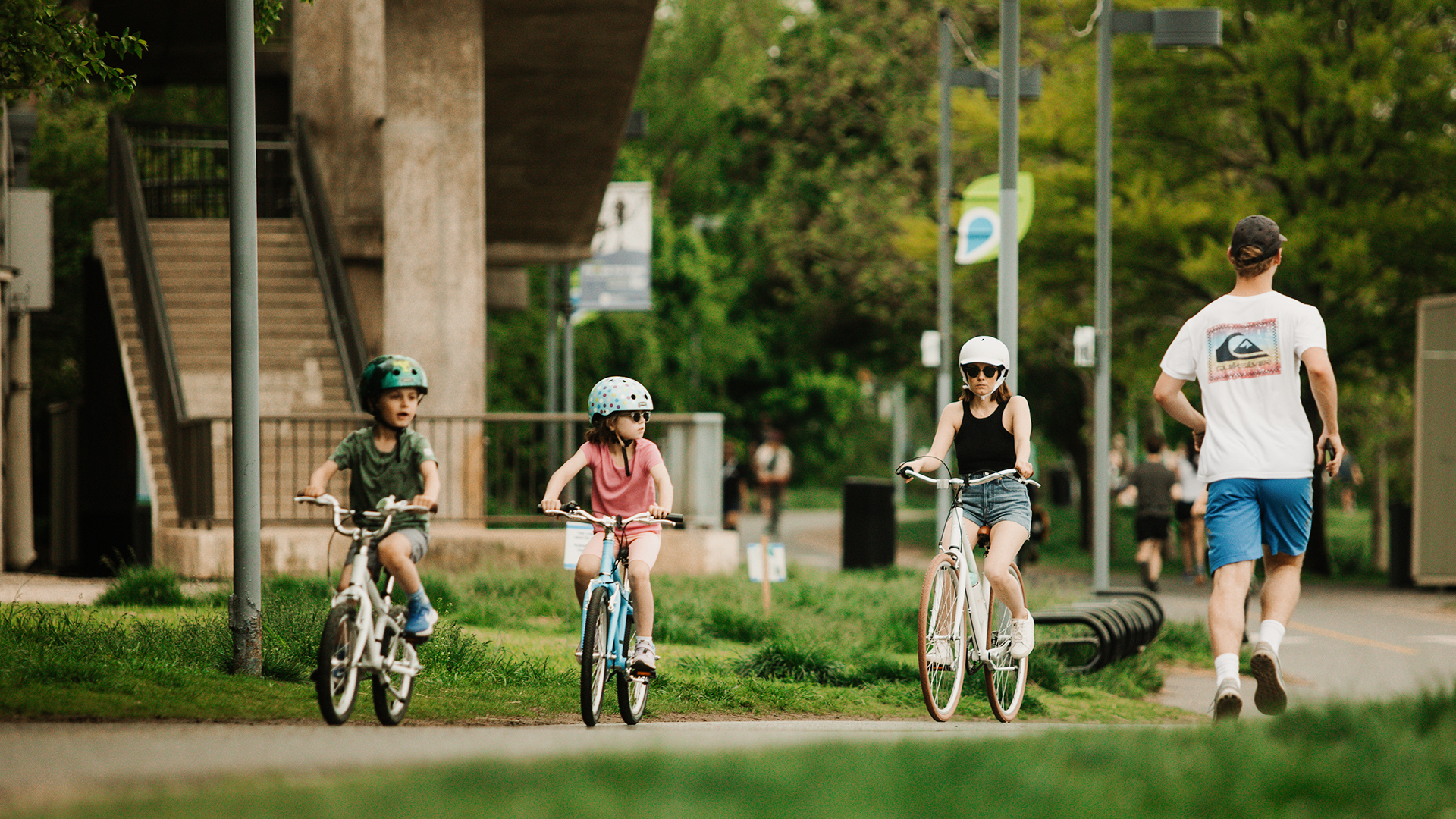
What’s 3,000 miles long, attracts 50 million annual visits, and stitches together 450 communities? It’s not an interstate (sorry for the trick question). It’s a nationally connected, locally rooted walking and biking trail from Maine to Florida, developed under the leadership of the East Coast Greenway Alliance.
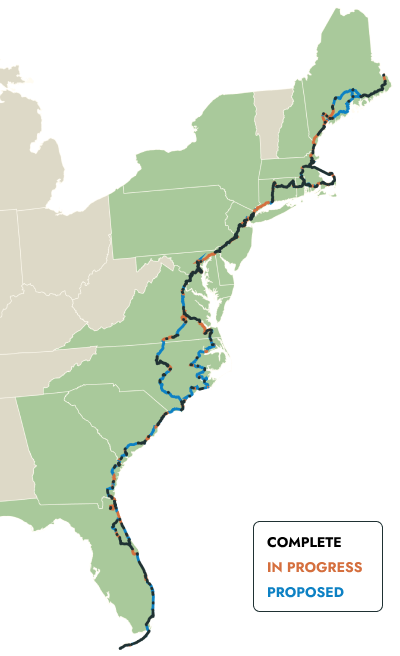
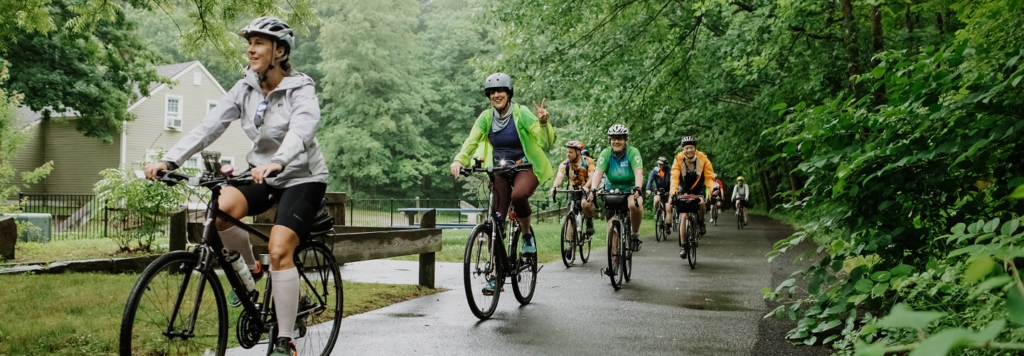
Founded in 1991, the nonprofit is dedicated to traffic-free routes for active transportation and recreation that support healthy communities, sustainable urban and rural environments, and thriving local economies. It welcomes walkers, bikers, rollers, and all the in-between-ers, whether they’re locals commuting to work or visitors discovering new neighborhoods.
But that’s just the surface-level “About Us.” Look a little closer, and you see a rare type of organization, one at the intersection of multiple movements, connecting 15 states around shared goals. We love an overachiever.
All the intersections: recreation, transportation, sustainability, public health, and connection
Community vitality
The Alliance works directly with local governments, nonprofits, and residents. The group helps plan, fund, and build segments that connect parks, main streets, schools, and offices. The result? A connected Greenway that’s safe for an everyday commute as much as a destination trail.
Staff and volunteers coordinate community events, celebrate new segment openings, and promote small businesses along the route, strengthening the social and economic fabric of 450 towns and cities.
And the work has real impact. ECGA gathers studies and impact reports to prove it. A continuous New Haven & Northampton Canal Greenway could:
- support between 351 and 582 jobs
- earn $20.0 to $33.5 million in wages
- generate $35.7 to $60.0 million in value added and $68.4 to $114.4 million in output
By positioning the Greenway as both neighborhood infrastructure and regional connector, the Alliance helps communities attract visitors, support local commerce, and build a shared sense of place along the trail.
Public health & wellness
Impact studies on East Coast Greenway segments in Pennsylvania and Delaware estimate that preventive health care savings from trail use reach about $46 million per year, with roughly $142 in annual healthcare cost savings per trail user who gets regular exercise thanks to nearby routes. That means every segment is more than a nice-to-have amenity; it’s a long-term investment in healthier communities and healthcare savings.
By creating a safe corridor for walking, biking, running, rolling, and even skiing and horseback riding on certain segments, the Alliance makes no-cost, close-to-home (or multi-mile marathon) physical activity possible for millions of people.
Environmental sustainability
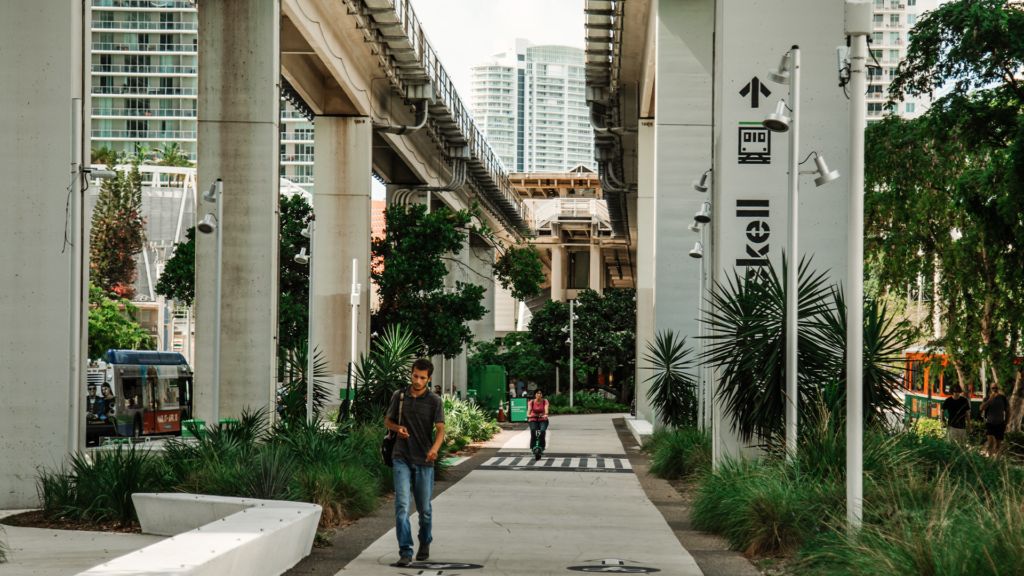
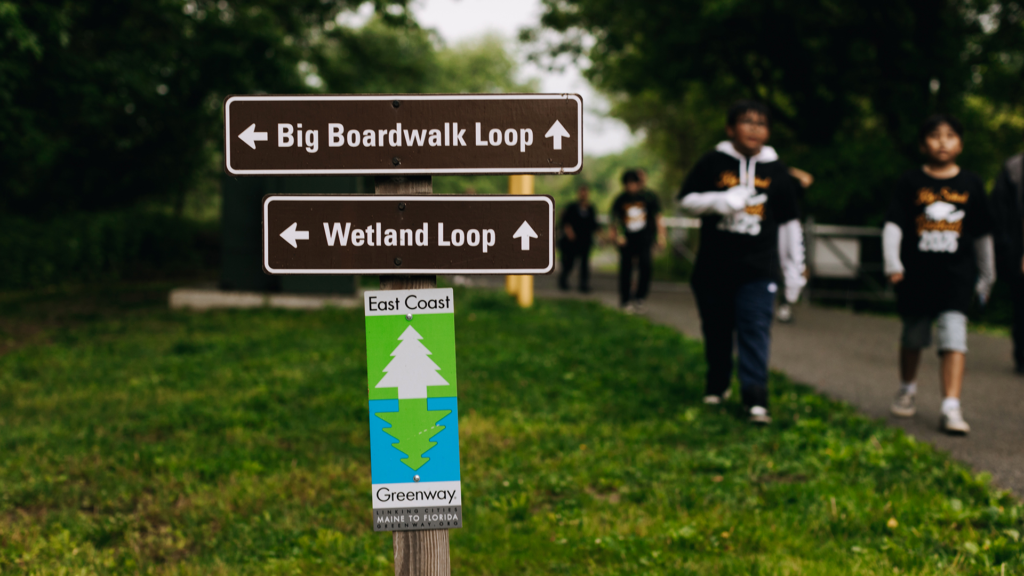
The Greenway’s trail design prioritizes the conservation and protection of rivers, wetlands, habitats, and tree canopies, while offering practical alternatives to car travel along the East Coast. The organization pushes for climate-resilient infrastructure, such as protected coastal and riverfront trail alignments, sustainable stormwater management, and direct connections to transit. The route reduces emissions, improves air and water quality, and bolsters communities against extreme weather.
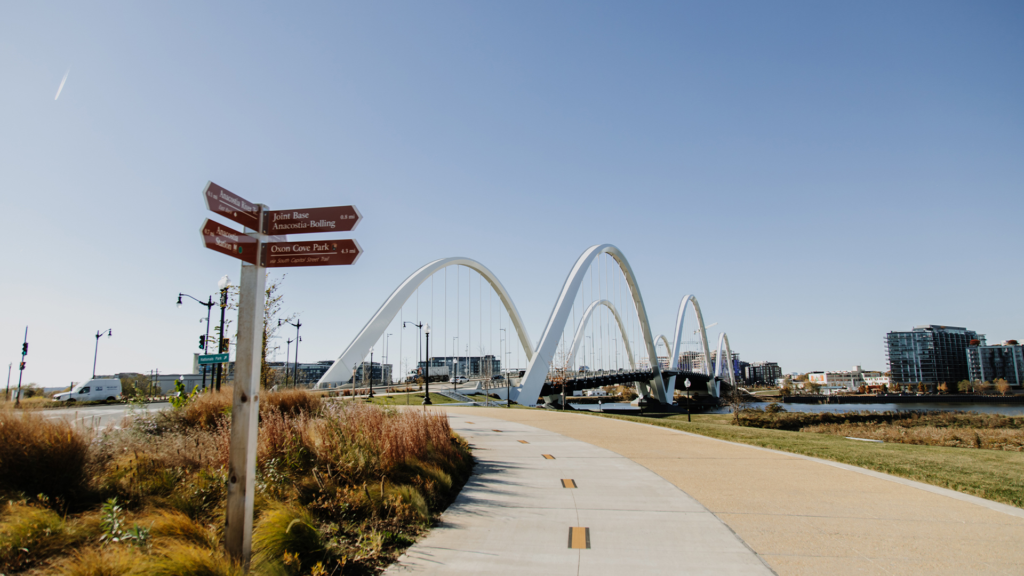
In Washington, D.C., the Capital Trails Network:
- prevents 19,580 metric tons of CO2 from being emitted every year
- protects 74,000 acres of tree cover along the route
Beyond the trail itself, the Alliance backs its environmental values with operational choices, investing in a green hosting platform for greenway.org and partnering with environmentally-friendly partner agencies whenever possible. It’s a powerful example of how mission and infrastructure can (and should) align.
Civic engagement
The Greenway energizes communities and mobilizes residents to speak up for safe streets and trails, whether through working with elected officials or participating in public meetings where Greenway projects are on the table.
The Alliance offers tools, sample messaging, and email lists so supporters can help shape how billions of public taxpayer dollars are invested in their own backyards. In Baltimore, Greenway partners organized more than 10 open houses, 7 community charrettes, 20+ tabling events, and 40+ listening sessions—directly engaging roughly 2,500 residents and building a 60‑member coalition that secured formal adoption of the trail network into city policy.
Accessibility and inclusion
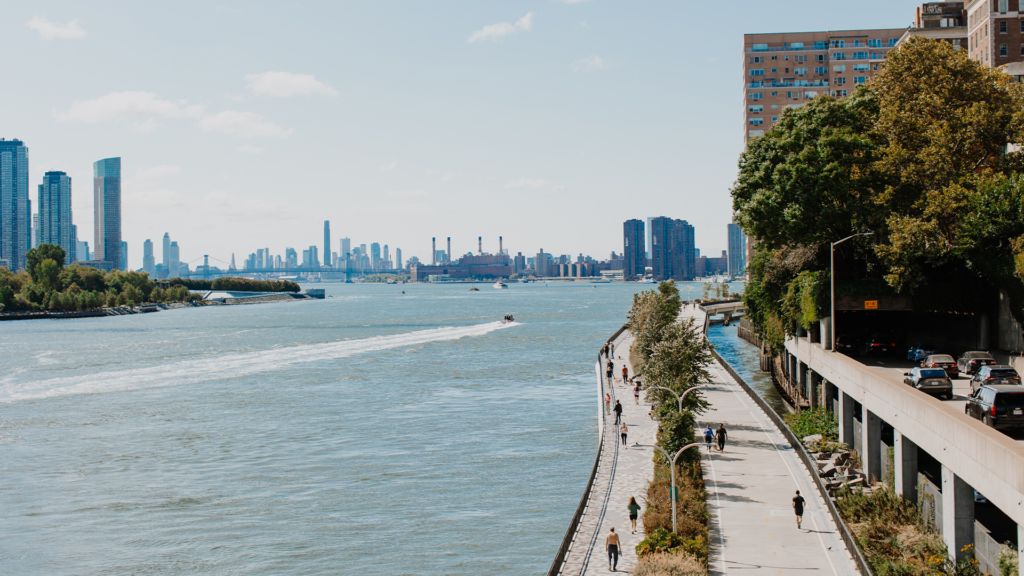
The Alliance’s design criteria always consider accessibility and inclusivity. Segments are planned to work not just for road bikes, but also for wheelchairs, adaptive bikes, and strollers. By pushing for traffic-free routes, appropriate surfaces, and safer intersections, the Alliance helps ensure people with disabilities, older adults, and families can move through the Greenway with safety, comfort, and independence.
The challenge of connecting 15 states… online
When the East Coast Greenway Alliance set out to redesign their website, they weren’t just looking for a visual refresh. They needed a modern digital home that matched the ambition and demands of the trail, something that could help people explore nearby segments or plan a multi-day adventure. And that includes understanding the deeper impact behind the Greenway, and seeing where their support fits in.
The Greenway is a big project… like, really big. Behind it sits decades of planning, partnerships, policy work, and construction, all generating a steady stream of stories, project updates, and resources. Add a 3,000-mile interactive map with route details for every state and region, plus trip-planning tools, and it’s a lot to ask of any single website.
The core challenge was simple to state and hard to do well: how do you make a national, multi-audience trail network feel intuitive and serve many purposes, without confusing visitors or losing the depth that makes it valuable?
Designing clean routes for many visitors and use-cases
Before we even considered information architecture and user experience (UX), we needed to understand why people come to greenway.org in the first place. That meant talking to the East Coast Greenway Alliance team and digging into site performance analytics and existing content.
Clear intent emerged: the site needs to work well for a family planning a weekend ride, a donor exploring the Alliance’s impact, and a partner seeking resources to advance a local segment.
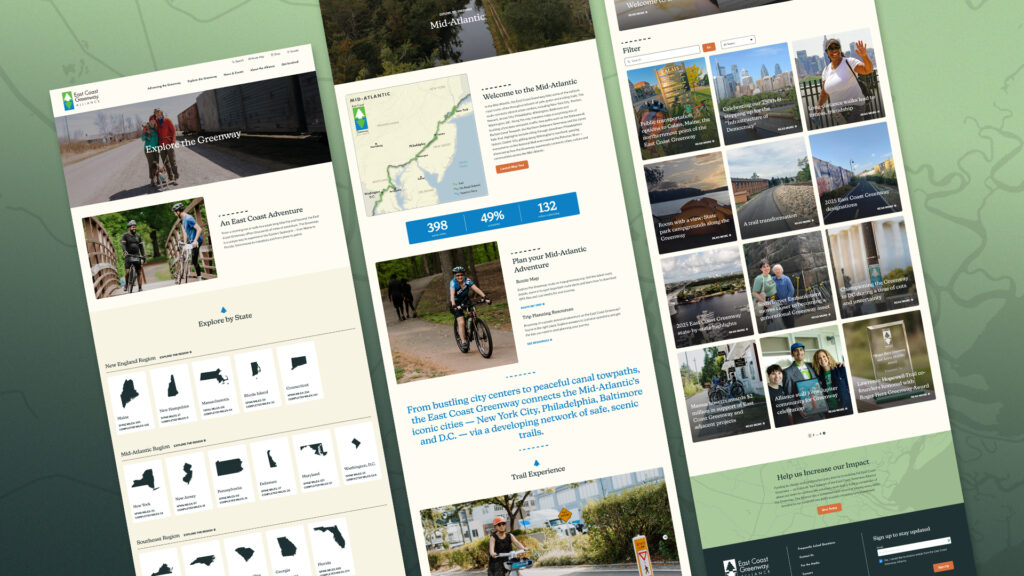
So we leaned into clarity, using these insights as our compass. The navigation bar and homepage now organize the user experience around those core jobs and audiences. Trip-planners can quickly find their way into state and regional views of the Greenway, prospective donors have straightforward pathways to action, and curious visitors know exactly where to go for the information they seek.
In other words, we created explicit trails for each type of visitor.
Keeping a large national site, with regional content, cohesive
Part B of this challenge: keeping the experience coherent across hundreds of pages. Large sites often drift into inconsistent layouts, labels, and page purposes, especially when they mix evergreen pages, news stories, maps, interactive modules, and geographically specific content.
To counter that, we developed clear page templates, content guidelines, and state-level taxonomies that help the Alliance maintain consistency over time. That structure makes it easier for staff to publish new content while ensuring visitors always feel like they’re still on the same well-marked trail.
Making it easy to find the best Greenway routes
For many users, the map is their first stop when they want to answer questions like “Does the trail go through my city?” or “How can I connect a few segments into a weekend ride?” That makes the map experience simultaneously one of the most important and most complex parts of the site.
The Alliance’s mapping work, in partnership with GreenInfo Network and countless local collaborators, has produced rich, detailed route data, including high-stress road sections, caution points, and trail types.
Our redesign honors that work and makes those details easily accessible by integrating the map intuitively into the “Explore the Greenway” flow, so it feels like a natural extension of the brand story, not a separate tool.
Elevating East Coast Greenway’s impact with a standout design
East Coast Greenway Alliance’s impact is much more than a few data points; it’s America’s most visited walking and biking trail. Encouraged to play within and extend their existing brand guidelines, we experimented with fresh applications of their greens and blues and introduced complementary secondary serif fonts. These subtle brand updates are paired with new iconography, map-centered design motifs, and uniquely-ECGA graphic elements.
The new design treats that earned status like the headline it is. We introduced a light tan background that lets the core greens and blues stand out, while a soft but vivid orange accent turns calls‑to‑action into clear, cannot‑miss prompts. We integrated video and photo content and energized the overall styling to uplift the tone of the website. Mapping elements and trail graphics throughout add character and keep the Alliance’s mission front-and-center.
We also went micro, spotlighting state-level stories with dynamic content, surfacing local wins, and telling the Alliance’s mission in a robust yet visually distinct way. It’s a design system built to celebrate the impact of the story, not just display information.
The community, from Maine to Florida and beyond, responded
With strong collaboration between East Coast Greenway Alliance and Vermilion, the early results have made us proud. Analyzing the same 60-day performance window, year-over-year, before and after site launch, we saw the following results.
- Email sign-up rate increased from 1.6% to 5.0%, more than doubling the list of engaged supporters
- Donation rates rose by 43%, helping fuel future trail projects
- Organic search click-through rate improved by 15.8%, bringing more organic explorers to the site
- Visitor engagement rate increased by 29%, with people spending more time interacting with content
- Events per session went up by 17.6%, signaling richer use of tools and resources
- Overall SEMrush website health score increased by 14.3%
- Average search position jumped 50% in rankings
- SEO scores for both desktop and mobile increased by 16.4%
Over the course of the redesign, we also migrated greenway.org to a green hosting platform, aligning the site’s infrastructure with the Alliance’s long-term focus on environmental sustainability.
For a deeper look at the site, visit Vermilion’s East Coast Greenway Alliance case study.
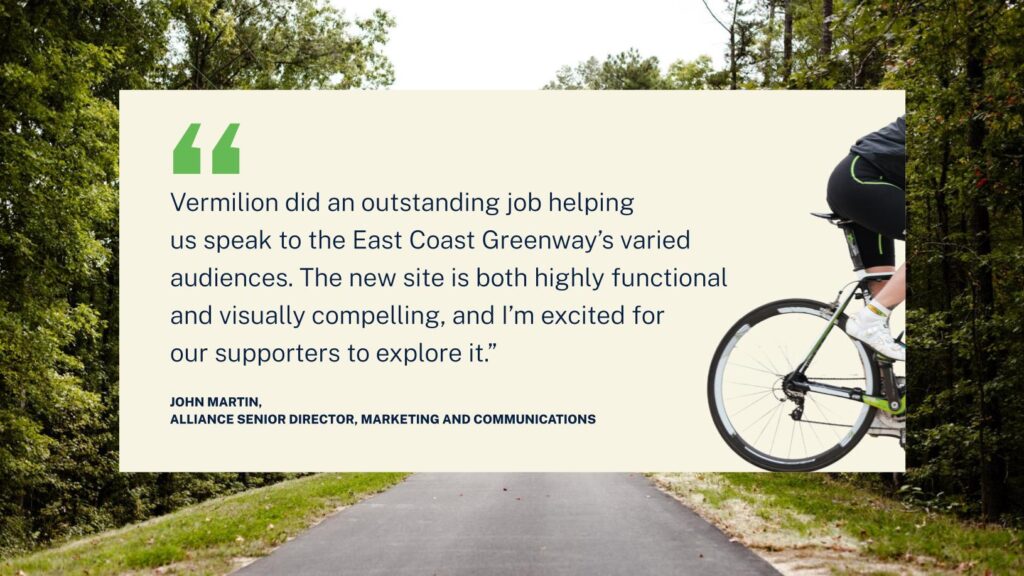
The importance of UX and website design for mission-driven companies
For organizations like the East Coast Greenway Alliance, a website isn’t just a brochure. It’s the front door to the work (and in this case, the play).
It’s where a family discovers a new way to spend their Saturday afternoon connecting with each other and nature, where a donor understands the real-world impact of their gift, and where partners find the tools they need to keep project momentum and increase local outdoor access.
When a mission spans thousands of miles, multiple social impact issues, and can’t-even-count-how-many stakeholders, a well-designed website (not just looks, but UX, content, and SEO) becomes one of the most powerful levers available. It turns curiosity into connection, connection into support, and support into the kind of sustained movement that pushes big, ambitious ideas like this forward.